
Geometry basics for calculating volume
Understand length, area, and volume, choose a shape formula, and combine sections without overlapping spaces or confusing radius and diameter.
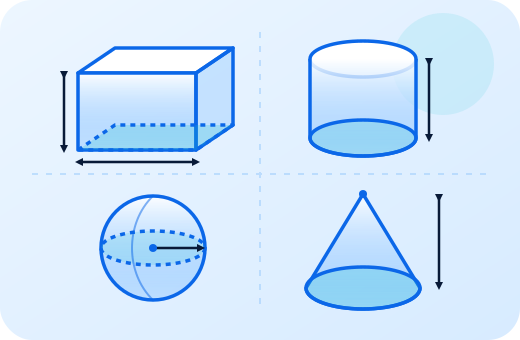
What the calculation represents
Geometry turns dimensions into volume once the shape is known. Length measures one direction, area measures a surface, and volume describes three-dimensional space. Start by choosing a suitable shape model rather than applying the box formula to every container.
- Reference formula
volume (L) = volume (cm³) ÷ 1,000- Unit reference
- 1 L = 1,000 cm³ · 1 m³ = 1,000 L · 1 US gal = 231 in³ = 3.785411784 L
A practical workflow
- Decide whether you need length, area, outside volume, or inside capacity, and label every measurement with its unit.
- Choose a shape model: box, cube, cylinder, sphere, or cone. Split a compound object into sections that do not overlap.
- Measure the required dimensions in one unit. Distinguish the full diameter from radius, and measure height perpendicular to the base.
- Calculate each section, add or subtract the relevant volumes, and convert the cubic result to liters at the end.
Worked example
A storage box measuring 12 × 8 × 6 inches inside has a 96 in² base and a volume of 576 in³. Using 1 in³ = 0.016387064 L gives about 9.439 liters. The 96 in² footprint alone does not tell you its capacity.
Reading the answer correctly
Use inside dimensions for capacity. Thick walls, molded corners, curved sides, and occupied space can make a geometric estimate larger than the usable amount; keep those allowances separate.
A calculation can be exact for its model while remaining an estimate for a real storage tote or tank. Record the dimensions, assumed shape, and allowances together so someone else can check what the number represents.
Length, area, and volume answer different questions
A box length is in inches, its footprint in square inches, and its volume in cubic inches. Each multiplication adds another direction. Plain inches or square feet cannot be converted to liters without the missing dimensions.
For an evenly thick layer, volume = area × thickness. A metric example is 2 m² × 0.05 m = 0.1 m³ = 100 L. When depth varies, divide the space into representative sections rather than inventing one uniform height.
Match the formula to the shape
Here V is volume, l, a, and h are length, width, and height, s is a cube edge, and r is radius. Use one length unit throughout. Height is perpendicular to the base, including for a cone.
Centimeter dimensions give cm³: divide by 1,000 for liters. Meter dimensions give m³: multiply by 1,000. Inch dimensions give in³: multiply by 0.016387064. These formulas describe complete shapes, not a partly filled horizontal tank.
Swipe horizontally to see every column
| Shape | Formula | Required dimensions |
|---|---|---|
| Rectangular box | V = l × a × h | Length, width, and height |
| Cube | V = s³ | One edge |
| Cylinder | V = π × r² × h | Radius and height |
| Sphere | V = 4/3 × π × r³ | Radius |
| Cone | V = π × r² × h ÷ 3 | Radius and perpendicular height |
Add sections and subtract cavities once
A stepped space can be divided into boxes. Two separate inside sections measuring 40 × 30 × 20 cm and 20 × 30 × 20 cm hold 24 L and 12 L respectively, totaling 36 L. Sketch the division and make sure no section has been included twice.
Subtract a cavity or displaced object only if the original volume included that space. Do not deduct headspace again after using the actual water depth. Arbitrary curves may need water displacement or a more suitable geometric model.
Report precision your measurements support
Extra decimal places cannot fix a poor shape assumption or a misplaced tape. Check inside dimensions and repeat the measurement with the greatest effect: radius is squared for a cylinder and cubed for a sphere.
Round the final result only. Keep geometric volume, current liquid contents, and usable capacity distinct. For a complex container, a stated range with assumptions can be more useful than an apparently exact single figure.
Checks before relying on the number
- Measurements span the inside when the question is how much a container holds.
- The selected formula describes the shape, and every dimension uses the same unit.
- Radius is half the diameter; vertical height is not a sloping side length.
- Sections do not overlap, and fittings, cavities, and headspace are counted only once.
Practical questions
Can square feet or square meters be converted straight to liters?
You need a height, depth, or thickness. Multiply an area by a height in the matching length unit to get cubic units, then convert those units to liters. A footprint alone does not determine capacity.
Should I use radius or diameter?
The circular formulas here use radius, half the full diameter. If the calculator field is set to Diameter, enter the measured diameter directly without halving it first. Check the field label before calculating.
What if the measurements use different units?
Convert every length to one unit before multiplying. For example, 1 m × 50 cm × 20 cm becomes 100 × 50 × 20 cm: 100,000 cm³, or 100 L. Feet and inches likewise need a consistent unit.
How can I measure an irregular object?
Split it into measurable, nonoverlapping sections and add their volumes, subtracting cavities where appropriate. For a suitable small object that can be immersed without reacting or absorbing water, displacement can be a better method.
Sources and references
These references support the units, method, or limitations explained in this guide.
- NIST — SI Units: Volume
Definitions and exact relationships between liters and cubic units.
- OpenStax — Prealgebra 2e, §9.6
Ideal rectangular-solid, cylinder, sphere and cone formulas; not a certification of product capacity.
- NIST — Guide to the SI, Appendix B.8
International inch and foot conversion factors; a volume conversion cubes the corresponding length factor.
- OpenStax — University Physics Volume 1, §14.4
Physical basis of immersion and displaced liquid volume; not treatment-dosing guidance.
Start here, then follow the guide for the specific shape or container. When a close fit matters, compare the estimate with measured filling or the manufacturer’s usable-capacity specification.
See how formulas, examples, and updates are reviewed.