
Volume units: liters and cubic meters
Read mL, L, cm³, dm³, and m³ correctly with exact equivalences, cubic conversion factors, and checks for decimal notation and the direction of conversion.
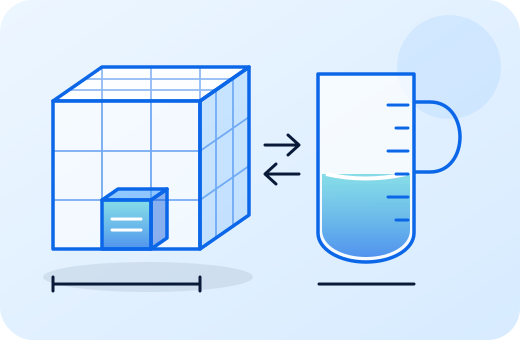
What the calculation represents
Liters, milliliters, and cubic meters all measure volume. One liter is one cubic decimeter, and one milliliter is one cubic centimeter. Learning the scale helps you read metric container labels and water-meter readings without confusing a length, a surface area, or a weight with volume.
- Reference formula
1 m³ = 1,000 L = 1,000,000 cm³- Unit reference
- 1 L = 1,000 cm³ · 1 m³ = 1,000 L · 1 US gal = 231 in³ = 3.785411784 L
A practical workflow
- Identify the full source unit: mL, L, cm³, dm³, or m³. Keep the cubic exponent attached to the number.
- Check which symbols the source uses for decimals and thousands, and retain the original digits before converting.
- Choose the matching equivalence. For dimensions, convert each length before calculating; for an existing cubic volume, cube the length conversion factor.
- Label the answer, reverse the conversion as a check, and round only to the precision supported by the original value.
Worked example
Six 1.5-liter bottles contain 9 L altogether: 9,000 mL or 0.009 m³. The unit changes the number, not the amount. Checking 0.009 × 1,000 returns the original 9 liters.
Reading the answer correctly
Check cubic exponents and the source’s decimal notation. Plain meters or square meters do not convert straight to liters, and converting liters to kilograms requires the material’s density.
These metric conversion factors are exact. Uncertainty comes from the measured or advertised input, not from the relationship between units. Showing more decimal places cannot improve an uncertain starting value.
How milliliters, liters, and cubic units fit together
The cubic meter is the SI volume unit. A liter is 1 dm³ and a milliliter is 1 cm³. To visualize one liter, imagine a cube with 10 cm edges: 10 × 10 × 10 cm = 1,000 cm³.
The table expresses each source unit in liters and cubic meters. The factor is the same for water, oil, or empty space because it converts volume. Their weights may differ, which is a separate question.
Swipe horizontally to see every column
| Source unit | In liters | In cubic meters |
|---|---|---|
| 1 mL | 0.001 L | 0.000001 m³ |
| 1 cm³ | 0.001 L | 0.000001 m³ |
| 1 dm³ | 1 L | 0.001 m³ |
| 1 L | 1 L | 0.001 m³ |
| 1 m³ | 1,000 L | 1 m³ |
Why a length conversion factor is cubed
Since 1 m = 100 cm, a one-meter cube has 100 cm along each edge: 100 × 100 × 100 = 1,000,000 cm³. Volume uses 100³; area would use 100². Applying the linear factor 100 to an existing m³ value gives the wrong result.
Convert all three dimensions to centimeters and calculate, or calculate in m³ and convert once afterward. Both routes should agree. US customary dimensions follow the same rule: 1 ft = 12 in, so 1 ft³ contains 12³ = 1,728 in³.
1 m³ = 100³ cm³ = 1,000,000 cm³1 m³ = 1,000 dm³ = 1,000 L
Read small values without losing three decimal places
In US notation, 0.125 m³ equals 125 L, while 1,250 L means twelve hundred and fifty liters, or 1.25 m³. A Spanish or German source may write 1.250 L and 1,25 m³. Identify the notation before copying a value.
Keep a leading zero for values below one: 0.001 m³ is 1 L. Use a familiar reference to check the scale. If a small household container converts to millions of liters, revisit the original unit and number format.
When a unit conversion is not enough
An area needs depth or thickness before it describes volume. A uniform layer across 10 m² with a height of 0.02 m has volume 0.2 m³, or 200 L. Varying thickness requires measurements or separate sections.
Liters and kilograms measure different quantities. Use mass = density × volume with compatible units. Also, converting a rated capacity does not establish usable capacity: actual fill level and displaced contents still matter.
Checks before relying on the number
- The original number measures volume, rather than length, area, or mass.
- Decimal points and thousands separators follow the source document’s notation.
- The factor works in the right direction: 1 m³ becomes 1,000 L, not 0.001 L.
- The reverse operation restores the source value, and an exact conversion is not mistaken for an exact measurement.
Practical questions
Is one liter exactly one cubic decimeter?
Yes: 1 L = 1 dm³. Similarly, 1 mL = 1 cm³ and 1 m³ = 1,000 L. These are exact volume-unit relationships, independent of the material.
When should I multiply or divide by 1,000?
Multiply for m³ to L and divide for L to m³. Multiply for L to mL; divide for mL or cm³ to L. Writing the starting and target units helps prevent using the factor backward.
Why is 1 m³ not 100 cm³?
The factor 100 converts length from meters to centimeters. Volume applies it in three directions: 100³ = 1,000,000. Thus 1 m³ is 1,000,000 cm³, or 1,000 L.
Can liters be converted directly to kilograms?
You need the material’s density under the relevant conditions. Multiply volume by density with matching units. Do not substitute water density for oil, fuel, soil, or another substance.
Sources and references
These references support the units, method, or limitations explained in this guide.
- NIST — SI Units: Volume
Definitions and exact relationships between liters and cubic units.
- NIST — Guide to the SI, Appendix B.8
International inch and foot conversion factors; a volume conversion cubes the corresponding length factor.
- OpenStax — University Physics Volume 1, §14.1
Mass, density and volume relationship. Verify the density of the actual product separately.
Keep the number and unit together. Follow the linked m³ or cm³ guide for a specific conversion; this overview explains how the scale works and how to choose and check the operation.
See how formulas, examples, and updates are reviewed.