
How to calculate rainwater collected from a roof
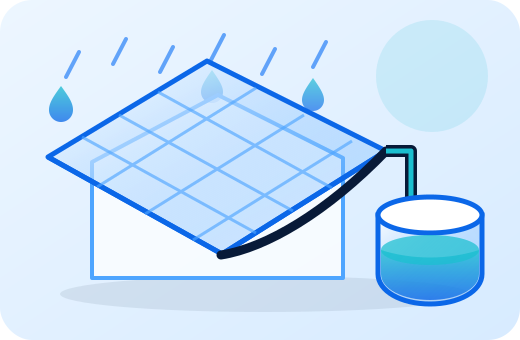
Estimate roof runoff from projected area, rainfall, and collection losses, then compare the result with the tank’s available storage.
Calculate with your own values
What the calculation represents
One millimeter of rain falling on one square meter equals one liter before losses. A practical storage estimate uses the roof’s horizontal projected area and a runoff coefficient for wetting, splash, evaporation, first-flush diversion, gutter loss, and collection efficiency.
- Reference formula
harvestable liters = projected roof area (m²) × rainfall (mm) × runoff coefficient- Unit reference
- 1 L = 1,000 cm³ · 1 m³ = 1,000 L · 1 US gal = 231 in³ = 3.785411784 L
A practical workflow
- Define the roof sections that actually drain to the same gutter system. Use their plan-view projected area; roof pitch does not create more rainfall over the site.
- Choose rainfall in millimeters for the event or period being assessed. A monthly total produces a monthly yield estimate, not the size of one storm.
- Multiply area by rainfall and apply a documented or measured runoff coefficient. Keep a known first-flush diversion as a separate deduction.
- Compare estimated inflow with the tank’s current free capacity and demand between storms. Any excess is potential overflow rather than usable storage.
Worked example
An 85 m² projected roof receives 24 mm of rain. With a 0.85 runoff coefficient, 85 × 24 × 0.85 gives 1,734 liters. A tank with only 1,000 liters of free capacity would overflow by about 734 liters unless extra storage is available.
How much rain can your roof collect?
Estimate the water reaching your tank and see how much will be stored or overflow during one rainfall event.
Reading the answer correctly
Do not treat a monthly rainfall total as one storm event, and do not assume roof runoff is drinking water without suitable treatment, testing, and compliance with local rules.
The result is potential inflow, not a guaranteed water supply. A site can have a strong annual yield and still run dry during a long gap between storms; daily rainfall sequence, demand, starting level, and overflow determine storage performance.
Which roof area belongs in the formula
For vertical rainfall, use the horizontal projection of every roof plane feeding the downpipe. Read it from a plan or multiply horizontal length by horizontal width, then add connected sections.
Wind-driven rain changes real distribution, but substituting the sloping roof surface normally creates a systematic overestimate. For closer planning, compare several measured storms with the observed tank-level rise.
1 mm × 1 m² = 1 Lnet inflow = gross inflow × runoff coefficientpotential overflow = max(0, net inflow − free storage)
Quick table for a 50 m² roof
Figures use a 0.80 runoff coefficient and are intended as an order-of-magnitude check. Replace every input with values supported for the site.
Swipe horizontally to see every column
| Rainfall | Gross rain volume | Estimated collection |
|---|---|---|
| 5 mm | 250 L | 200 L |
| 10 mm | 500 L | 400 L |
| 20 mm | 1,000 L | 800 L |
| 30 mm | 1,500 L | 1,200 L |
| 50 mm | 2,500 L | 2,000 L |
Checks before relying on the number
- The area includes only roof planes connected to the tank and excludes surfaces draining elsewhere.
- Rainfall comes from a representative station and covers the same interval used in the storage plan.
- The runoff coefficient is stated as an assumption and does not duplicate separately deducted losses.
- Gutters, downpipes, filter, overflow route, and tank base are suitable for the expected flow and stored mass.
Practical questions
Should I use sloping roof area or projected area?
Use the horizontal projected area that drains to the system. Pitch changes rafter length but not the volume of vertical rain falling on the building footprint.
Which runoff coefficient should I use?
There is no universal number. Roofing, pitch, maintenance, filters, and first flush all matter. Use a documented design value or calibrate it from rainfall and observed tank rise.
How do I size the storage tank?
Run a daily water balance using local rainfall and daily demand. Annual rainfall alone hides dry spells, already-full tanks, and overflow during intense events.
Is harvested roof water safe to drink?
It is not potable by default. Roof materials, wildlife, dust, and storage can introduce hazards; potable use requires suitable design, treatment, testing, and compliance with local requirements.
Sources and references
These references support the units, method, or limitations explained in this guide.
- AEMET OpenData
Official Spanish meteorological observations and datasets for selecting representative rainfall.
- US EPA National Stormwater Calculator
Official tool for modeling site rainfall, runoff, and stormwater controls.
- German Environment Agency: sustainable rainwater use
Public-agency guidance on appropriate uses, limits, and system planning.
Record connected area, rainfall period, coefficient, first-flush loss, and free capacity. That audit trail makes the estimate easy to update after roof or demand changes.
See how formulas, examples, and updates are reviewed.